
Description
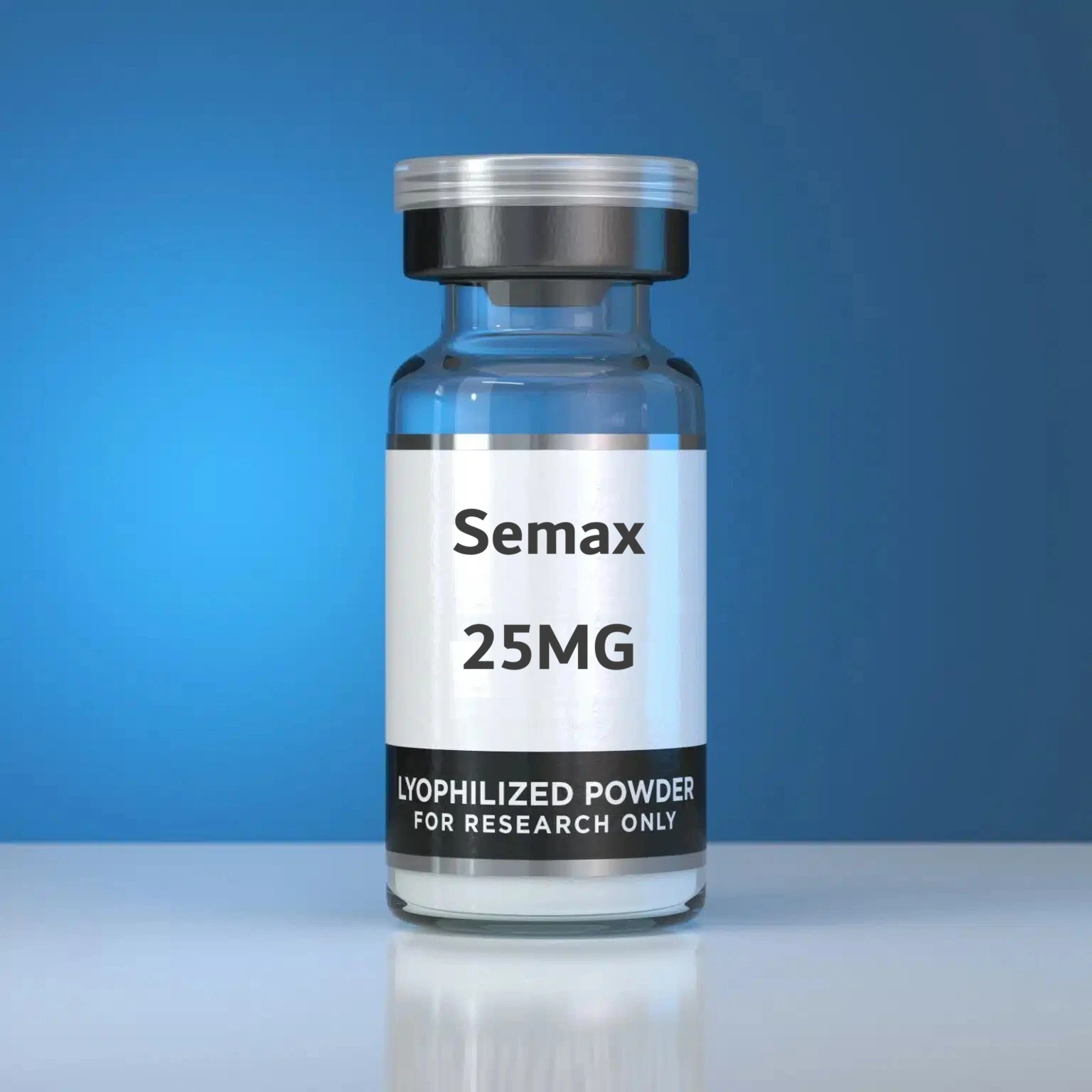
Semax 25mg Peptide
Semax 25mg Peptide for sale online at Peptides Link Laboratory.
Buy Semax, a synthetic peptide derived from a short fragment of adrenocorticotropic hormone (ACTH), specifically ACTH(4–10). The peptide is structurally modified with the addition of a Pro-Gly-Pro tripeptide at the C-terminal end. Also, a modification designed to improve stability and potential activity in laboratory models. Research interest in Semax has centered on its possible influences in neuroprotection, gene expression, neurotransmission, and neuroplasticity.
Benefits & Effects of Semax 25mg :
- Neuroprotection: Protects brain cells from damage, particularly during oxygen deprivation (hypoxia) or stroke, and helps neurons survive glutamate toxicity.
- Cognitive Enhancement: Stimulates memory, attention, and learning, potentially by increasing BDNF (Brain-Derived Neurotrophic Factor).
- Stroke Treatment: Used clinically in Russia for acute ischemic stroke, improving outcomes and protecting the nervous system.
- Neurotrophic Support: Improves the brain’s trophic (nutrient) supply and promotes cell proliferation and migration.
- Immune & Vascular Support: Affects the immune and vascular systems, potentially boosting immunity and improving blood flow.
- Analgesic Properties: Can reduce pain sensitivity, though this effect might differ from its cognitive benefits.
Research Confirmed Effects of Semax
1. Semax and Brain Effects
The effects of Semax on the default mode network (DMN) of the brain were investigated using resting state functional magnetic resonance imaging (fMRI). Two groups of healthy volunteers participated in the study. With resting state fMRI conducted before and after intranasal administration of Semax or a placebo. The results showed that Semax led to a greater volume of the DMN’s rostral subcomponent compared to the placebo group. Thus, indicating its impact on the brain’s neuronal network. Additionally, the relationship between the DMN and the “social brain” was explored, revealing overlaps between brain areas activated during social cognition tasks and those associated with the DMN. This suggests that the DMN plays a role in social cognition. Hence, shedding light on the brain’s functioning during both rest and social cognitive tasks.
The default mode network (DMN) is typically more active during rest but can be activated by certain tasks, including social cognition. Higher-order tasks like attributing mental states to others engage areas overlapping with the DMN. Evidence from functional MRI meta-analyses and studies on social brain connectivity supports this claim. Recent findings also suggest the presence of a DMN in non-human primates. These observations have implications for understanding brain function during rest and social cognitive tasks.
2. Semax in Stroke
The peptide Semax, known for its neuroprotective properties in brain stroke therapy, was investigated for its effects on gene expression in rat brain cortex tissues during focal ischemia. Results revealed that Semax significantly influenced the expression of genes related to the immune and vascular systems. Notably, Semax predominantly enhanced the expression of immune system-related genes, including those encoding immunoglobulins and chemokines. Moreover, Semax altered the expression of genes associated with vascular development and function. Also, suggesting its potential role in promoting the formation and functioning of the vascular system during ischemia. These findings suggest that Semax’s neuroprotective effects may be mediated through its impact on immune and vascular processes in the brain.
In clinical research evaluating Semax’s efficacy in ischemic stroke patients. The administration of Semax was found to increase plasma brain-derived neurotrophic factor (BDNF) levels, irrespective of the timing of rehabilitation. Higher BDNF levels were positively correlated with early rehabilitation and were associated with accelerated improvement in motor performance and Barthel index scores. Early rehabilitation combined with Semax administration demonstrated enhanced functional recovery and motor performance improvement, indicating the potential benefits of Semax in facilitating neurorehabilitation and improving outcomes in patients recovering from ischemic stroke.
3. Semax and Gene Expression
Semax containing ACTH4-7 and Pro-Gly-Pro, enhances neuron survival in hypoxia and memory storage. It induces gene expression changes, particularly in BDNF and NGF, in the rat hippocampus and frontal cortex. Hippocampus plays critical roles in memory and learning, while the frontal cortex is important in concentration, planning, and organizing information. Following a single intranasal dose (50 mg/kg), gene expression initially decreases in the hippocampus but increases in the frontal cortex. Levels return to baseline after 40 minutes, then significantly rise by 90 minutes, reaching maximum levels within 8 hours before returning to baseline. This suggests Semax rapidly and specifically activates BDNF and NGF expression in different brain regions.
4. Semax and Cognitive Benefits
Special study explored the potential cognitive benefits of adrenocorticotropic hormone (ACTH) in epileptic mice. While ACTH is commonly used to manage seizures in various epilepsy syndromes, its effects on cognitive function independent of seizure control are unclear. The study administered ACTH via Acthar Gel intraperitoneally to KO mice and found that it prevented impairment of long-term potentiation (LTP) in the hippocampus and restored spatial learning and memory on the Barnes maze test. Interestingly, ACTH treatment did not significantly impact the frequency of spontaneous recurrent seizures. These findings suggest that ACTH may have direct cognitive-enhancing effects in epileptic mice beyond seizure control, highlighting its potential as a nootropic agent in the epileptic brain.
5. Semax 25mg and Depression
Antidepressants such as Selective Serotonin Reuptake Inhibitors (SSRI) act as indirect agonists of serotonin (5-HT) receptors. Although these drugs produce a rapid blockade of serotonin transporters (SERTs) in vitro, several weeks of treatment are necessary to observe clinical benefits.
Study investigates the bidirectional effects of brain-derived neurotrophic factor (BDNF) on serotonin (5-HT) neurotransmission and behavior in mice. Decreasing BDNF levels in heterozygous BDNF+/- mice leads to increased basal extracellular 5-HT levels in the hippocampus and resistance to the antidepressant effects of SSRIs, indicating genetic resistance to serotonergic antidepressants. Conversely, increasing BDNF levels in wild-type mice through intra-hippocampal injection enhances the response to SSRIs, correlating with improved antidepressant-like activity. However, BDNF also induces anxiogenic effects, which are prevented by SSRIs. Interestingly, BDNF exerts opposing effects on the functional activity of the serotonin transporter (SERT). Hence, reducing its capacity to reuptake 5-HT without increasing basal 5-HT levels in the hippocampus. This suggests a complex interplay between BDNF, serotonergic neurotransmission, and behavior, with potential implications for developing new antidepressant therapies.
6. Semax 25mg in Stress Conditions
The study investigated the impact of intraperitoneal administration of the peptide Semax on the morphofunctional state of hepatocytes in male Wistar rats experiencing chronic emotional and painful stress. Results showed a dose-dependent stress-alleviating effect of the peptide, normalizing liver protein synthesis function and serum ALT activity. The anticytolytic effect of Semax increased with higher doses, indicating enhanced reparative processes in the liver parenchyma via elevated constitutional protein synthesis.
Additionally, the effect of Semax intraperitoneal injection on lipid peroxidation and serum transaminase activity was studied in Wistar male rats under acute and chronic immobilization stress conditions. Peptide administration across the dose range exhibited antioxidant effects in hepatocytes and significantly increased serum ALT and AST activity at the highest dose under chronic stress. However, prooxidant effects were observed at a moderate dose under acute stress, with changes in ALT and AST activity dependent on Semax dosage. These findings underscore the complex dose-dependent effects of Semax on hepatic function and stress response in rats.



Reviews
There are no reviews yet.