

Description
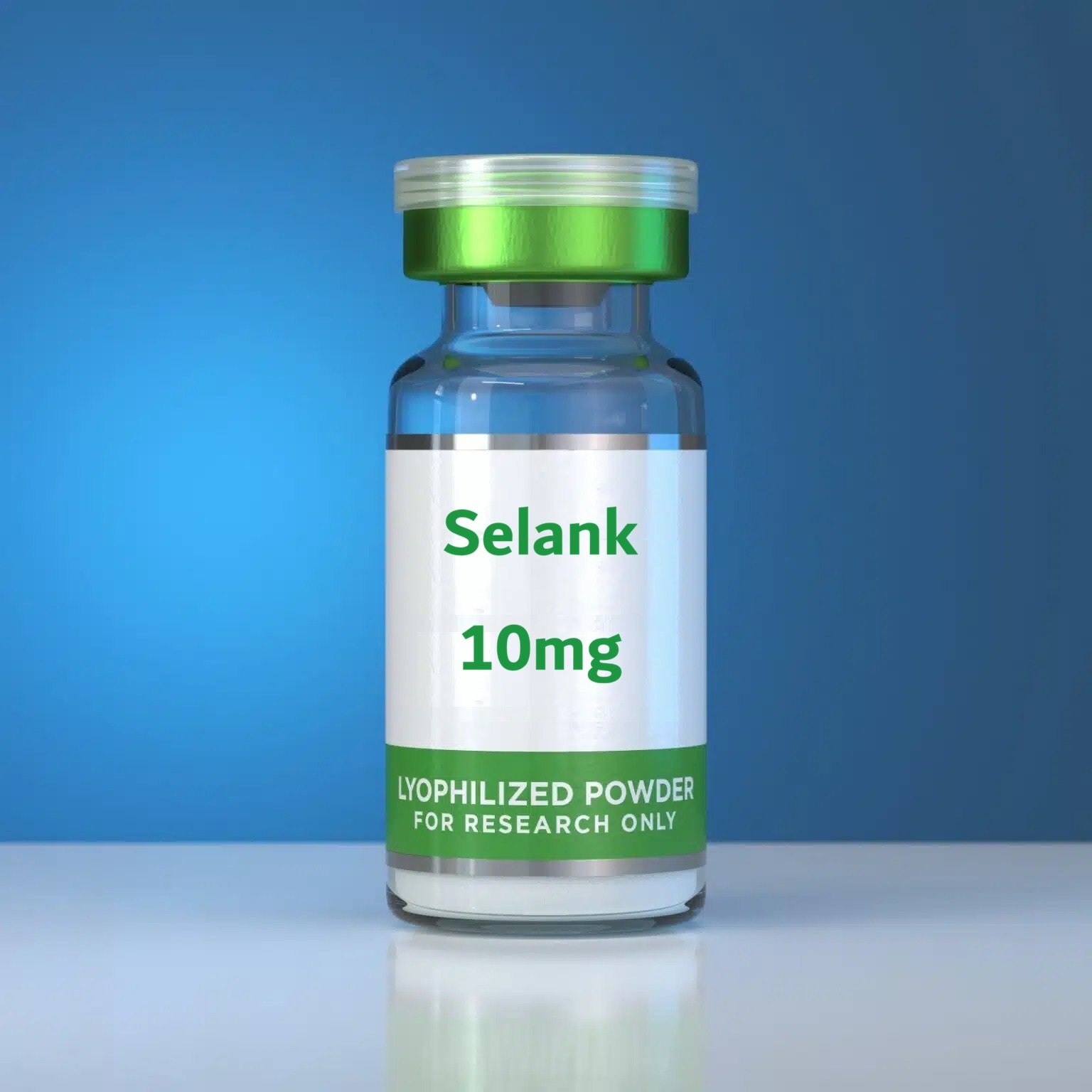
Selank 10mg Peptide
Selank 10mg Peptide for sale online at Peptides Link Laboratory.
Buy Selank, a synthetic heptapeptide (Thr-Lys-Pro-Arg-Pro-Gly-Pro), engineered as a stable analog of tuftsin with an added Pro-Gly-Pro fragment to improve metabolic stability and duration of action (Volkova et al. 2016). Molecular studies have shown that Selank modulates gene expression linked to neurotransmission, particularly within the GABAergic system. In rat models, it altered transcription of multiple GABAA receptor subunits and transporters. Consistent with allosteric modulation of GABAA receptors rather than direct agonism. This regulatory influence extends beyond GABA, with observed effects on dopamine and serotonin receptor pathways. Supporting its classification as a multifunctional neuropeptide regulator (Volkova et al. 2016).
Experimental data further demonstrate that Selank produces effects comparable to classical benzodiazepines and can potentiate the anxiolytic action of diazepam under stress conditions. Thus, suggesting shared molecular targets at GABAA receptors (Kasian et al. 2017). Clinical research additionally characterizes Selank as a tuftsin analog with neurometabolic and regulatory actions on monoamine turnover. Hence, associated with stabilization of excitatory–inhibitory balance and modulation of emotional–cognitive processes (Verbenko & Verbenko 2018). Together, these findings position Selank as a synthetic regulatory peptide with complex, system-level activity mediated through GABAergic and monoaminergic mechanisms.
Research Confirmed Effects of Selank 10mg
1. Selank in Anxiety Disorders Based on Genes Related to GABAergic System
Selank, a synthetic peptide with anxiolytic properties, has been found to influence the expression of genes involved in neurotransmission. Specifically those associated with the GABAergic system. Clinical studies have shown the similarity of the spectrum of physiological effects, and mechanism of action of Selank and classical benzodiazepines, such as diazepam and phenazepam.
In a study assessing the gene expression in the frontal cortex of rats 1 and 3 hours after Selank or GABA administration. Hence, significant changes were observed in the expression of 45 genes within the first hour and 22 genes after 3 hours. These genes included major subunits of the GABA receptor, transporters, ion channels, and receptors for dopamine and serotonin. The correlation between the changes in gene expression after administration of Selank or GABA indicates that Selank has complex effects on nerve cells and may modulate the GABAergic system. Hence, suggesting a mechanism of action similar to benzodiazepines.
Additionally, studies on different strains of mice with varying emotional and stress reactions revealed that Selank could produce anxiolytic effects in certain mice by prolonging the half-life of enkephalins in the blood. Specifically, in BALB/c mice. Selank at a dose of 100 micrograms/kg increased the half-life of plasma leu-enkephalin and produced anxiolytic effects in the open-field test. However, in C57Bl/6 mice, it did not significantly affect behavioral reactions or enkephalinase activities. This indicates that Selank’s ability to inhibit enkephalin-degrading enzymes is associated with its anxiolytic activity and may offer a potential therapeutic mechanism for managing anxiety and related disorders.
2. Selank as an Immunomodulator
Selank demonstrates unique immunomodulatory effects, making it a potential therapeutic agent in anxiety-asthenic disorders. Research in vitro indicated that Selank suppressed gene expression of interleukin-6 (IL-6) in patients with depression but not in healthy controls. Interestingly, an increase in IL-6 concentration was observed in cell cultures from the peripheral blood of patients when treated with Selank. Furthermore, a 14-day course of Selank in patients with generalized anxiety disorder (GAD) and neurasthenia resulted in changes in the Th1/Th2 cytokine balance. These findings suggest that Selank may act as an immunomodulator, with adaptogenic properties beneficial for elderly people and those exposed to environmental stressors, potentially helping prevent infectious diseases.
Selank is closely related to Semax, and its effects. Semax as a peptide derived from adrenocorticotropic hormone (ACTH) and Pro-Gly-Pro, is known for its neuroprotective and cognitive-enhancing effects. Study explored the effect of Semax on the expression of brain-derived neurotrophic factor (BDNF) and nerve growth factor (NGF) genes in the rat hippocampus and frontal cortex following a single intranasal administration (50 mg/kg). The research revealed that Semax administration leads to rapid and dynamic changes in gene expression in these brain regions.
3. The Impact of Selank on Learning and Memory Processes
Selank is derived from the endogenous tetrapeptide tuftsin, and has been extensively studied for its effects on learning, memory, and serotonin (5-HT) metabolism in rats. In one experimental setup. The rats trained with food rewards were injected with either Selank (300 micrograms/kg). Or saline after the 10th trial in a series of 30 trials per day. The experiment continued 30 minutes later with elaboration of conditioned reflex and later testing of retention after 24 hours, 7 days, and 30 days. The results showed that Selank activates 5-HT metabolism in the hypothalamus and caudal brainstem within 30 minutes to 2 hours of administration. Moreover, Selank injection during the consolidation phase led to increased memory trace stability over 30 days. Also, suggesting that it could play a role in enhancing memory storage processes.
Beyond anxiety, Selank appears to directly boost cognitive functions, as indicated by its impact on memory trace stability. This effect is notable as it is independent of the animal’s anxiety levels. Implying that Selank has a more direct influence on memory and learning. Additional studies showed that Selank could modify the expression of several genes in the hippocampus and affect the mRNA levels of 36 different genes. Most of which are associated with plasma membranes. These results suggest that Selank could modulate ion-dependent processes involved in learning and memory. Thus, highlighting its potential as a cognitive enhancer.
4. Selank and Restoration of Cognitive Processes After Brain Injury
Selank has also shown potential in restoring cognitive processes following damage to the brain. In one study, rats treated with a neurotoxin that selectively damages catecholaminergic neurons during early ontogeny were injected with Selank (300 micrograms/kg). Selank demonstrated an ability to restore cognitive processes that had been compromised due to chronic inhibition of the catecholaminergic system. This suggests that Selank might play a role in repairing or supporting cognitive functions following brain damage.
5. Selank 10mg in Pain Perception
The heptapeptides Semax and Selank have been shown to inhibit enkephalin-degrading enzymes in human serum in a dose-dependent manner. These synthetic compounds demonstrated inhibitory effects at lower concentrations compared to other known inhibitors, such as puromycin, bacitracin, and others. Enkephalins are endogenous peptides that interact with opioid receptors, playing a role in reducing pain intensity. Additionally, they are involved in the body’s stress response, with high concentrations typically located in the brain and adrenal glands. Selank 10mg
Interestingly, the pentapeptide fragments derived from these heptapeptides also exhibited inhibition of these enzymes. Whereas shorter fragments—tri-, tetra-, and hexapeptides—did not. Since enkephalin-degrading enzymes are involved in breaking down not just enkephalins but other regulatory peptides. Hence, it’s likely that the inhibitory action of Semax and Selank contributes to their overall biological effects. This inhibition could play a role in maintaining higher levels of important regulatory peptides. Thus, providing a potential explanation for some of the physiological effects observed with these compounds.







Reviews
There are no reviews yet.