
Description
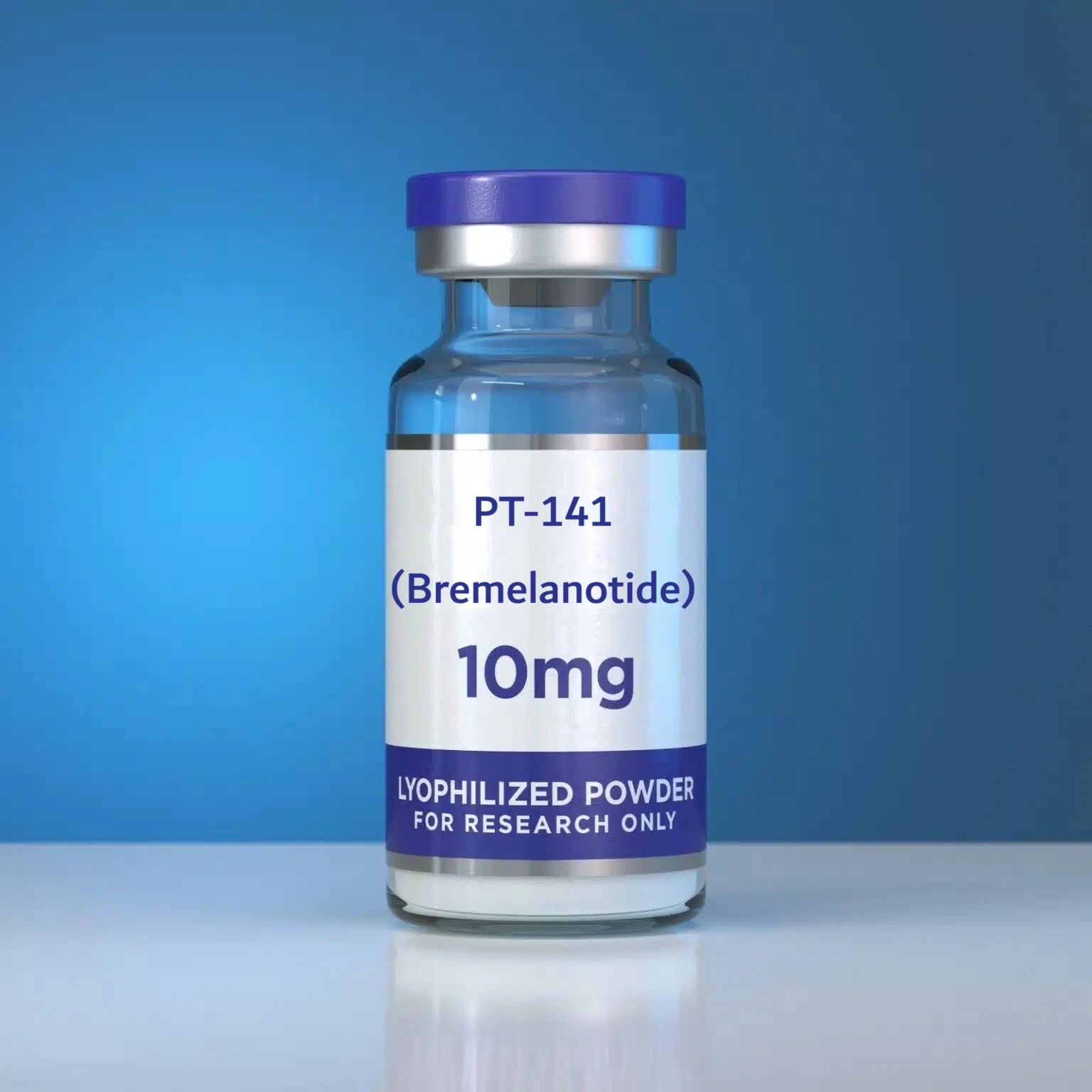
PT-141 (Bremelanotide) 10mg
PT-141 (Bremelanotide) 10mg Peptide for sale online at Peptides Link Laboratory.
Buy PT-141, also known as Bremelanotide, is a synthetic melanocortin analog derived from Melanotan 2 (MT-2). Also, Melanocortin analogs are synthetic compounds that may mimic or influence the functions of natural melanocortin peptides, such as alpha-melanocyte stimulating hormone (α-MSH). These natural peptides appear to be involved in processes including pigmentation, appetite regulation, immune responses, and energy balance.
In addition, PT-141 was developed to interact primarily with the Melanocortin-4 Receptor (MC-4R), although other melanocortin receptors (MC-1R, MC-2R, MC-3R, and MC-5R) may also play varying roles in physiology. For instance, MC-1R appears linked to pigmentation, MC-2R to adrenal activity, MC-3R to metabolic regulation, and MC-5R to exocrine functions such as sweating and sebum production.
Buy PT-141 (Bremelanotide) 10mg
Buy PT-141 (Bremelanotide), a synthetic heptapeptide analogue of the naturally occurring hormone Alpha-Melanocyte Stimulating Hormone (α-MSH) at Peptides Link Laboratory. Unlike traditional PDE5 inhibitors which act on the vascular system, PT-141 is investigated for its mechanism of action within the Central Nervous System (CNS). Thus, Preclinical research suggests it acts as a potent non-selective agonist at melanocortin receptors, specifically MC3R and MC4R in the hypothalamus. These receptors are critical modulators of sexual behaviour and arousal signaling. Supplied as a lyophilized powder strictly for laboratory research.
Area of Interest of PT-141
Research on PT-141 has focused on central neurobiological pathways:
- Firstly, Melanocortin Signaling (MC4R).: Investigated for its ability to bind to MC4R receptors in the brain, triggering a cascade of neural signals associated with physiological arousal.
- Sexual Dysfunction Models: Extensively studied in animal models of Hypoactive Sexual Desire Disorder (HSDD) and Erectile Dysfunction (ED) to understand the difference between central (brain) vs. peripheral (blood flow) stimulation.
- Hemorrhagic Shock: Early research explored potential utility in circulatory shock due to melanocortin receptor influence on blood pressure regulation.
- Lastly, Inflammatory Modulation.: Like other alpha-MSH analogues, it is researched for potential downstream anti-inflammatory effects via the melanocortin system.
These properties make PT-141 a primary reagent for laboratories investigating neurobiology, receptor affinity, and the physiological mechanics of arousal.
Technical Information of PT-141 (Bremelanotide)
- Chemical Name: Bremelanotide (PT-141)
- Synonyms: PT141, Cyclo-[Nle4, Asp5, D-Phe7, Lys10]-alpha-MSH
- Molecular Formula: C₅₀H₆₈N₁₄O₁₀
- Molecular Weight: 1025.2 g/mol
- Sequence: Ac-Nle-Asp-His-D-Phe-Arg-Trp-Lys-OH (Cyclic lactam bridge)
- CAS Number: 189691-06-3
- Peptide Classification: Melanocortin Receptor Agonist / Alpha-MSH Analogue
Storage Guidelines of PT-141 (Bremelanotide)
- Firstly, Lyophilized peptide is stable at room temperature for several weeks.
- For long-term storage, keep at −20°C or below.
Lastly, Once reconstituted, store at 2–8 °C. Effective use depends on the solution used.
Solubility of Bremelanotide
PT-141 is soluble in sterile water, saline, or bacteriostatic water. It reconstitutes easily without acidic buffers.
PT-141 (Bremelanotide) Storage & Handling
- Prior to reconstitution: store ≤ 8 °C in a dry environment
- After reconstitution: refrigerate 2 – 8 °C and use within 30 days
- For long-term preservation: aliquot and freeze at −20 °C
- Avoid repeated freeze–thaw cycles

Reviews
There are no reviews yet.